Since 2004, within the framework of the long-standing Aeschylia Festival, visual arts interventions—first at the Kronos factory and subsequently at the Old Oil Mill of Eleusis—undoubtedly placed another landmark on the country’s artistic map.
At the same time, the visual arts interventions in these spaces established a meaningful framework for how the ruins of our industrial heritage ought to be utilized.
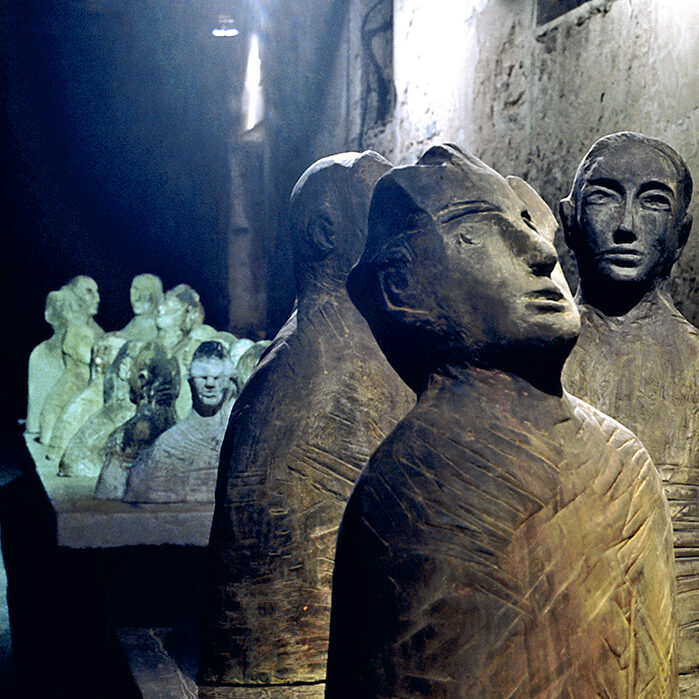
“…I loved the open square with the fig tree—its age, its strength, and its tenderness. The grand, unified sum of all these elements from any sequence, angle, or viewing distance was irresistible to me. Seeing the site for the very first time, I was completely captivated…”
Η επιλογή των εικαστικών εγκαταστάσεων στηρίχθηκε στην αρχή: ένας χώρος- ένας καλλιτέχνης. Πρόκειται για μια προσπάθεια που θέλει να ξεφύγει από το πνεύμα των ομαδικών προσεγγίσεων και εκθέσεων, όπου συχνά χάνεται η απαραίτητη προσοχή στην ατομική υπόσταση και προσπάθεια, αλλά και στην ιδιοτυπία της έκφρασης.
It is true that today’s world—the world of mass media—is by far the largest and most effective machine for producing images, far surpassing today’s art system in both scale and efficacy.
In this context, as Boris Groys wrote, the artist exists as today’s ‘last manual laborer’—simultaneously responsible for conceiving, designing, and physically producing the artwork. Thus, they stand little chance of pitting their art against the overwhelming power of these image-generating machines.
We sought to offer space and the means of realization to this ‘last manual laborer,’ aiming to create an enduring work—so that the public, walking through the body and spirit of each artist, might gradually forge a relationship with Art rooted in lived, rather than mediated, experience.
The history of visual arts exhibitions at the Aeschylia Festival over roughly the past fifteen years is, I would argue, concurrently a history of contemporary installation art in Greece.
Artists such as Vana Xenou, Theodoros, and Kalliopi Lemos charted the initial steps of the institution’s history, addressing themes such as the sacred in art and the symbols of the Eleusinian myth; the industrial site and its reconstitution as a cultural asset; and the sanctity of a space defined by female symbols, upon which an altar of wrecked migrant boats was erected. This marked the first phase, where the venue functioned as a shell and a symbolic substrate to host works conceived and produced within the artists’ studios.
Subsequently, nearly all works—across the greater part of their exhibition—became site-specific creations produced in situ. This encompassed not merely the physical fabric of the space as an artistic element, but also the social context embedded in the human fabric of the city. Marios Spiliopoulos with Traces of People, Stefanos Tsivopoulos with The Future Starts Here, Michelangelo Pistoletto with Third Paradise, and the organized procession of the Venus of the Rags through the city’s streets staged by Mary Zygouri, all epitomize works whose primary raw material is the intangible resonance of Eleusis’s history.
Finally, in the works of Leda Papaconstantinou, Diohandi, Stephen Antonakos, Nikos Navridis, Tarek Atoui, Eleni Panouklia, and Danae Stratou, there is a marked insistence on the viewer’s literal presence. The spectator enters the artwork, engaging with all their senses; beyond sight alone, their very body reacts as they listen, feel, and even experience fear—thereby partaking in the unmediated, visceral experience offered by the totality of the installation.

